XT.com Fees Explained: What a $100 Spot or Futures Trade Really Costs

Updated September 2026. Trading fees look small when they are quoted as percentages, but the effect becomes much easier to understand when you convert them into dollars. This guide explains what a $100 spot or futures trade on XT.com can cost at standard rates, how maker and taker fees work, what changes when leverage is involved, and which extra costs are not included in the headline trading fee.
Important: XT.com uses tiered pricing and can apply different rates based on VIP status, account assets, trading volume, promotions, product, or market. Always check the official XT.com fee schedule while logged in before placing a trade. Certain coins or products can have special fee rules.
XT.com Fee Snapshot: The Numbers That Matter
For a standard, non-VIP example, commonly published XT.com rates are approximately:
| Market | Maker Fee | Taker Fee | Cost on $100 Notional |
|---|---|---|---|
| Spot | 0.20% | 0.20% | $0.20 per executed side |
| Futures | 0.04% | 0.06% | $0.04 maker / $0.06 taker per executed side |
XT states that VIP levels and fee rates are updated daily based on account status. That means your personal rate may be lower than the baseline used in this article. The exchange also notes that some markets can use special fee mechanisms, so the live rate page is the final reference.


What Does a $100 Spot Trade Cost on XT.com?
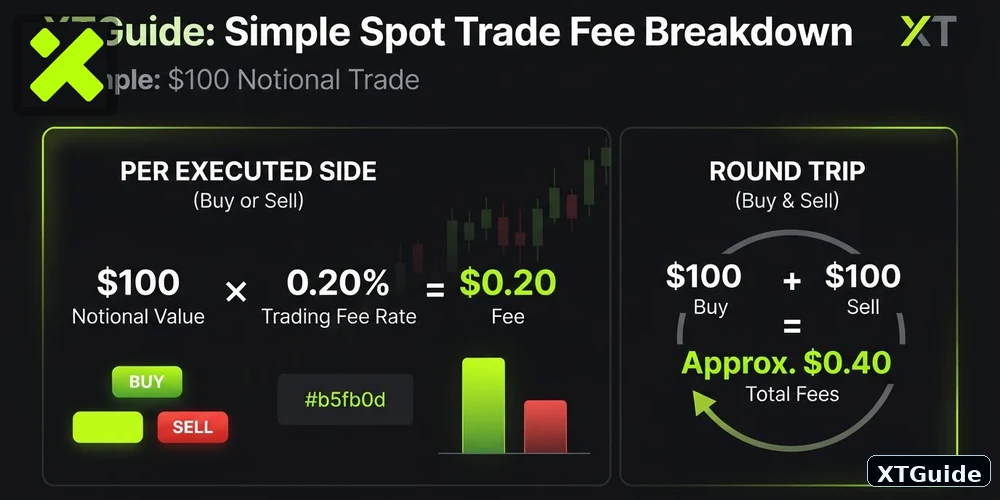
At a 0.20% spot fee, a $100 executed order costs:
$100 × 0.20% = $0.20
If you later sell roughly $100 worth of the same asset and the same fee rate applies, the approximate trading commission for the full buy-and-sell cycle is:
$0.20 to buy + $0.20 to sell = about $0.40 round trip
This is a simplified example. Your exit notional may be higher or lower after the asset price moves, so the second fee is calculated from the actual value of the executed sell order.
Spot example
| Action | Notional | Fee Rate | Approx. Fee |
|---|---|---|---|
| Buy BTC/USDT | $100 | 0.20% | $0.20 |
| Sell BTC/USDT | $100 | 0.20% | $0.20 |
| Round trip | Approx. $200 total executed volume | — | $0.40 |
For a walkthrough of the spot interface, order types and market selection, see our XT Spot Trading guide.
Maker vs Taker: Why Order Type Can Change Your Cost
A maker order adds liquidity to the order book, usually because a limit order waits instead of executing immediately. A taker order removes existing liquidity, which is common with market orders and marketable limit orders.
On the standard spot example above, maker and taker are both 0.20%. Futures pricing is more sensitive to the distinction because the baseline rates differ. If you trade actively, the difference can become meaningful over hundreds of entries and exits.
What Does a $100 Futures Trade Cost on XT.com?
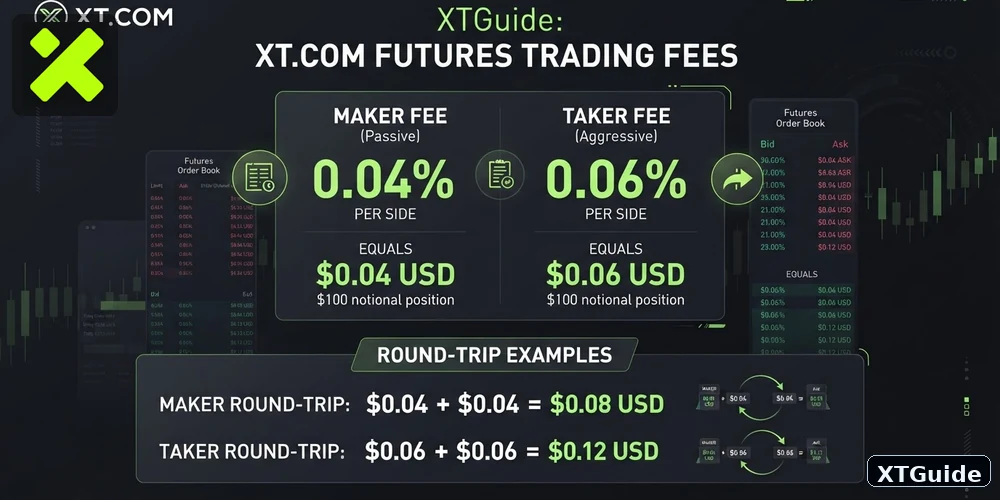
Futures fees are charged on the executed position notional, not simply on the cash margin you deposit.
For a $100 futures position at a baseline 0.04% maker fee:
$100 × 0.04% = $0.04 per side
At a 0.06% taker fee:
$100 × 0.06% = $0.06 per side
| $100 Futures Position | Entry | Exit | Approx. Round Trip |
|---|---|---|---|
| Maker on both sides | $0.04 | $0.04 | $0.08 |
| Taker on both sides | $0.06 | $0.06 | $0.12 |
| Maker entry + taker exit | $0.04 | $0.06 | $0.10 |
Learn how XT perpetual contracts, leverage and liquidation work in our XT Futures Trading guide and our detailed high-leverage crypto exchange guide.
The Big Leverage Mistake: $100 Margin Is Not a $100 Trade
This is where many beginners underestimate futures fees. Suppose you deposit $100 as margin and use 10× leverage to open a $1,000 position. Your commission is calculated on the $1,000 notional.
| $100 Margin at 10× | Fee Rate | Entry Fee on $1,000 | Approx. Same-Notional Round Trip |
|---|---|---|---|
| Maker | 0.04% | $0.40 | $0.80 |
| Taker | 0.06% | $0.60 | $1.20 |
Leverage magnifies exposure, profits, losses and the dollar impact of notional-based trading fees. It also increases liquidation risk. A lower commission does not make a leveraged position low-risk.
Trading Fee Is Not the Whole Cost
The commission is only one component of real execution cost. Depending on how you trade, the following can matter just as much:
- Spread: the difference between the best bid and ask.
- Slippage: the difference between the expected price and your actual execution, especially during volatility or in thin markets.
- Funding: periodic payments between long and short traders on perpetual futures. Funding can be a cost or a credit depending on the rate and your position.
- Withdrawal fees: asset- and network-dependent charges when moving crypto off the exchange.
- Conversion or payment-provider costs: relevant when funding an account through certain fiat or third-party payment routes.
XT’s own educational material emphasizes that comparing exchanges only by the headline maker/taker number can be misleading because spread, funding and withdrawal costs can alter the all-in result. See XT.com’s official guide to crypto exchange fees.
How Funding Can Change the Cost of Futures
Perpetual futures do not expire, so exchanges use funding payments to help keep contract prices aligned with the underlying spot market. Funding is separate from the maker/taker commission. Depending on the prevailing rate, longs may pay shorts or shorts may pay longs.
If you open and close a futures trade before a relevant funding settlement, you may avoid that particular payment. If you hold through multiple funding intervals, the cumulative funding can exceed your entry and exit commissions. Always check the live funding rate on the contract before holding a position.
How to Reduce XT.com Trading Fees
There are several practical ways to improve fee efficiency:
- Check your current VIP tier and personalized rates before trading.
- Use limit orders when appropriate and understand whether the order will actually execute as maker liquidity.
- Avoid unnecessary overtrading; every executed entry and exit creates turnover.
- Monitor available fee deduction vouchers and promotions in XT’s Rewards Hub.
- Compare networks before withdrawing, because withdrawal costs can vary substantially.
The official XT Rewards Hub currently advertises new-user rewards and task-based benefits, while the exact availability, amounts, qualifying actions and validity periods can vary by account, region and campaign.
Exclusive XT Sign-Up Benefits
Unlock Exclusive XT Benefits
Sign up through XT’s exclusive link to get trading fee discounts, a $50 welcome bonus, and up to $8,000 in trading capital.
If you want the full onboarding process first, read How to Register on XT.com. You can also review our dedicated XT Referral Code guide and XT Exchange Bonus guide.
$100 Cost Comparison: Spot vs Futures
| Scenario | Approx. One-Side Fee | Approx. Round Trip* |
|---|---|---|
| $100 spot, base rate | $0.20 | $0.40 |
| $100 futures, maker | $0.04 | $0.08 |
| $100 futures, taker | $0.06 | $0.12 |
| $100 margin controlling $1,000 futures, maker | $0.40 | $0.80 |
| $100 margin controlling $1,000 futures, taker | $0.60 | $1.20 |
*Round-trip examples assume the exit has approximately the same notional as the entry and do not include funding, spread, slippage or other costs.
Are XT.com Fees Cheap?
For small spot traders paying the standard 0.20% rate, the direct commission is easy to calculate but can add up if you trade frequently. Futures headline rates are lower, yet leverage can make the actual dollar fee larger because commission is applied to position notional. The right comparison therefore depends on your trading style, order type, turnover, VIP status and whether you hold perpetual positions through funding periods.
Fee level should also be considered alongside platform access, liquidity, execution, security and withdrawal requirements. For a broader platform review, see Is XT Exchange Safe? and our XT withdrawal fees and limits guide.
FAQ
How much does XT.com charge for a $100 spot trade?
Using a 0.20% standard spot rate, a $100 executed order costs about $0.20 in trading commission. A buy and later sell at roughly the same $100 notional would cost about $0.40 in total trading fees.
How much does a $100 XT futures trade cost?
At baseline rates of 0.04% maker and 0.06% taker, a $100 position costs about $0.04 as a maker or $0.06 as a taker per executed side. A same-notional round trip is therefore about $0.08 maker/maker or $0.12 taker/taker before funding and slippage.
Does 10× leverage multiply the fee?
The fee is based on your executed position notional. If $100 of margin controls a $1,000 position at 10× leverage, the fee is calculated on $1,000, not $100.
Does XT.com charge funding on futures?
Perpetual futures use funding payments. Funding is separate from maker/taker trading fees and can be paid or received depending on the contract’s live funding rate and your position.
Can XT.com fees change?
Yes. XT uses tiered and account-dependent pricing, updates VIP status regularly, and can apply special rules or promotional rates. Check the official live fee page before trading.
Bottom Line
For a straightforward $100 notional example, the baseline commission is roughly $0.20 per side on spot, $0.04 per side for a futures maker order, or $0.06 per side for a futures taker order. The key word is notional: with leverage, a $100 margin balance can represent a much larger trade and therefore a much larger fee.
Before placing an order, confirm your personalized rate on the official XT.com fee page, check funding if you are trading perpetual futures, and review any current Rewards Hub vouchers or promotions that may reduce your effective cost.
Risk disclosure: Crypto assets and leveraged derivatives are high-risk products. Leverage can amplify losses and may lead to liquidation. This article is educational and does not constitute financial advice.